
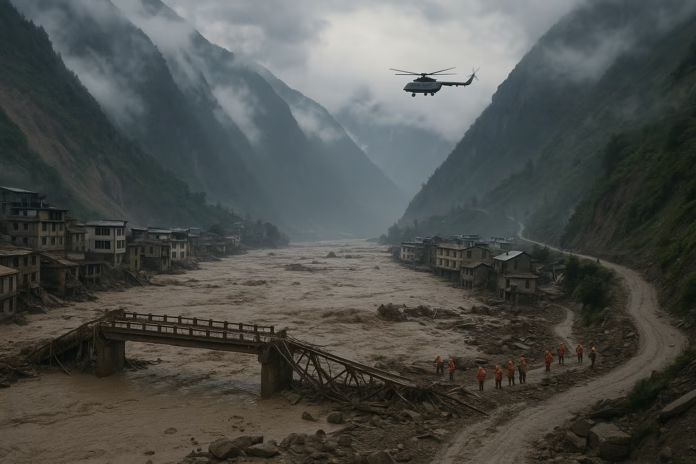
At least 168 people are confirmed dead after a glacial collapse triggered catastrophic flash floods, mudflows and landslides along the Nepal-Tibet border, according to the latest Associated Press reporting. Rescue teams in Nepal and China are searching through devastated river valleys where roads, homes, bridges and communications links were swept away or buried under mud.
The death toll is expected to change as search operations continue. Nepalese authorities have reported 826 people missing, while Chinese state media reported 558 missing in Tibet’s Gyirong area. Those figures would total 1,384 only if the two lists are entirely separate. That has not been independently established, and officials have warned that cross-border travel, disrupted communications and incomplete registration may produce overlap.
Collapse mistaken initially for an earthquake
The U.S. Geological Survey initially detected what appeared to be a magnitude 4.4 earthquake north of Kathmandu. After reviewing seismic records and satellite imagery, the agency said the signal was instead produced by a far larger glacial collapse, which it assessed at a magnitude equivalent of 5.2. USGS said no tectonic earthquake had occurred.
The collapse sent ice, rock, water and sediment racing through the Lhende Khola river system and downstream tributaries connected to the Bhote Koshi and Trishuli rivers. In a steep Himalayan landscape, such flows can rapidly gather debris, turning floodwater into a dense and highly destructive slurry capable of moving vehicles, damaging multistorey buildings and cutting roads within minutes.
The Kathmandu-based International Centre for Integrated Mountain Development (ICIMOD) said available evidence indicates that an ice-rock avalanche from a glacier likely blocked the river before releasing a sudden downstream surge. ICIMOD reported an exceptionally rapid rise in the Trishuli River, with water levels at one monitoring point increasing by as much as 9 metres in about 30 minutes.
Rescue operations face damaged roads and continuing hazards
The worst damage in Nepal has been reported in Rasuwa and Nuwakot districts, including communities and transport routes connected to the border crossing toward Gyirong. Nepal Army helicopters have evacuated stranded people, including foreign nationals, and transported injured survivors for treatment in Kathmandu. Searchers have also recovered bodies far downstream in Chitwan district, underscoring the distance debris and floodwaters travelled.
On the Tibetan side, authorities reported extensive mud deposits around Gyirong Port, damaged roads and interrupted communications. Chinese state broadcaster CCTV said continuing rain and unstable terrain could cause secondary collapses or landslides. A barrier lake discovered near the affected area has added another risk: such lakes can fail suddenly if water overtops or breaches a natural debris dam.
Foreign pilgrims and tourists are among those unaccounted for. Authorities and foreign ministries have reported missing travellers from several countries, including people travelling toward Mount Kailash, a site of religious importance for Hindus, Buddhists, Jains and Bon practitioners. Australia said it was seeking information on 34 citizens, while Malaysia said it was trying to contact dozens of nationals affected by the communications disruption. These are missing-person reports, not confirmed fatalities.
A repeat warning for Himalayan river valleys
The disaster struck a region that suffered destructive flooding only about 14 months earlier, when a glacial lake overflow in Tibet damaged infrastructure including a bridge linking Nepal and China. The repeated impacts highlight how exposed mountain communities, hydropower facilities, trade corridors and pilgrimage routes are to sudden high-altitude hazards.
Scientists caution that the precise chain of events in this disaster will require further field and satellite investigation. It is confirmed that a major glacial collapse occurred and that it generated the deadly downstream flood. It is analysis, rather than a final finding, that warming temperatures, melting ice, unstable slopes and intense rainfall may have combined to increase the likelihood or severity of this specific event.
That broader concern is well established. Research synthesised by ICIMOD has found rapid glacier retreat across the Hindu Kush Himalaya, while disaster specialists have repeatedly warned that growing exposure downstream makes early-warning systems, evacuation planning and cross-border data-sharing increasingly urgent. In this emergency, however, the immediate priority remains finding survivors and producing reliable casualty lists.
What is confirmed: at least 168 deaths have been reported across the disaster zone; a glacial collapse, rather than an earthquake, triggered the event; and large-scale rescue operations are under way in Nepal and Tibet.
What remains uncertain: the final death toll, the number of unique missing people, the degree of overlap between Nepalese and Tibetan missing-person lists, and the full physical sequence that transformed the collapse into such a devastating flood.
Sources
Associated Press: Nepal-Tibet flood and glacial-collapse reporting
Reuters: Australia seeks information on missing citizens
Reuters: Survivor and rescue reporting from Nepal
The Guardian: Visual explanation of the flood sequence
Al Jazeera: Rescue operations in the border region
U.S. Geological Survey: Earthquake Hazards Program
International Centre for Integrated Mountain Development
Nepal National Disaster Risk Reduction and Management Authority
Xinhua News Agency, English service
Australian Department of Foreign Affairs and Trade
Malaysia Ministry of Foreign Affairs
International Federation of Red Cross and Red Crescent Societies


